
Jump to:
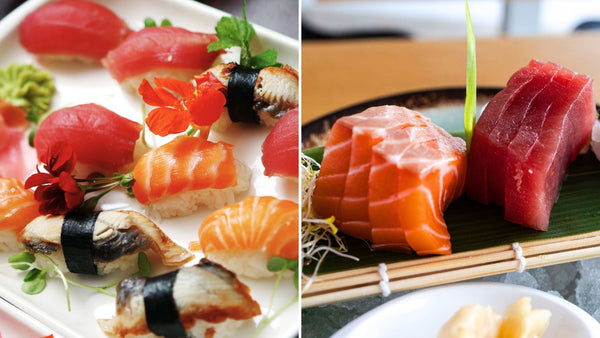
The main difference between sushi and sashimi is rice: sushi always includes vinegared sushi rice, while sashimi does not.
Sushi can be made with raw or cooked seafood, vegetables, egg, and other ingredients, while sashimi most commonly consists of carefully sliced raw fish or seafood served on its own.
Depending on where you are, there can be very different ideas about what sushi actually is. Outside Japan, sushi is often associated with California rolls, spicy tuna rolls, or simply “raw fish on rice.” Sashimi is even less understood and is sometimes mistaken for just the “raw fish part” of sushi.
But there’s much more to both Japanese dishes. In this guide, we explore sushi and sashimi from a Japanese perspective, including their origins, preparation methods, and the key differences that set them apart.
What is Sushi?

Sushi is a Japanese dish centered around specially prepared vinegared rice, known as shari (seasoned sushi rice), which is paired with ingredients such as seafood, vegetables, egg, or seaweed. Although sushi is often associated with raw fish, it is the seasoned rice, not raw fish, that defines sushi.
The word “sushi” is thought to come from an old Japanese word meaning “sour,” reflecting sushi’s fermented origins. Ancient Chinese writings used the character 鮓 (zhǎ) for fermented fish, further highlighting the historical connection between sushi and sour, fermented foods.
Behind modern sushi lies an ancient method of fermenting and preserving fish with rice. One surviving example is funazushi, a traditional fermented fish specialty associated with Lake Biwa. Its long fermentation produces an intensely pungent, acidic, and briny flavor.

Over time, sushi evolved away from lengthy fermentation. Instead, vinegar was added to rice to recreate the characteristic sourness much more quickly. This seasoned sushi rice, called shari, is typically prepared with rice vinegar, sugar, and salt.
Sushi comes in many forms, including nigiri, makizushi, temaki, chirashizushi, oshizushi, and inarizushi. For a closer look at popular varieties, preparation, and how to enjoy them, explore our complete guide to sushi.
What is Sashimi?
 Sashimi is a Japanese dish of thinly sliced fresh ingredients, most commonly raw fish or seafood, served without sushi rice. It is typically enjoyed with soy sauce and wasabi.
The word sashimi comes from Japanese sashi, meaning “to pierce,” and mi, meaning “flesh” or “body.”
Several theories explain the name, including an old practice of attaching the fish’s head and tail to the sliced meat so diners could identify what they were eating. Sashimi is thought to have developed from namasu, an earlier Japanese dish of thinly sliced fish prepared with vinegar.
Today, sashimi extends beyond seafood and can include preparations such as basashi (horse), torisashi (chicken), and even konjac or tofu skin.
From different cuts of tuna to yellowtail, sea bream, and uni, sashimi offers plenty of variety. Explore our complete guide to sashimi for popular types, preparation, and how to enjoy them.
Common Sashimi Cutting Styles
Probably the most important thing about sashimi is how the flesh is cut. This can fundamentally change the texture, taste and experience, but often a specific type of flesh requires a corresponding cut or slicing method (zukiri).
This video from 日本さばけるプロジェクト (Japan Sabakeru Project) demonstrates five techniques:
Hira-zukuri Flat Cut: A classic sashimi cut that creates relatively thick, rectangular slices. Commonly used for fish such as tuna and salmon.
Sogi-zukuri Angled Cut: The knife is held at an angle to create wider, thinner slices. This technique increases the surface area of each piece and is often used for firmer fish.
Usu-zukuri Thin Cut: Fish is sliced extremely thin, sometimes almost translucent. Often used for firm-textured white fish such as sea bream and flounder.
Ito-zukuri Thread Cut: The ingredient is cut into very fine, thread-like strips. It is commonly used for squid and other ingredients suited to delicate slicing.
Matsukawa-zukuri Pine-Bark Style: A technique in which the skin is left on the fish and briefly exposed to hot water before cooling. The resulting skin pattern resembles pine bark, which gives the technique its name.
Sushi vs. Sashimi: Key Differences
The key difference is simple: sushi always includes shari (vinegared sushi rice), while sashimi does not.
|
Category |
Sushi |
Sashimi |
|---|---|---|
|
Rice |
Always includes vinegared rice |
No rice |
|
Main Ingredient |
Seafood, vegetables, egg & more |
Usually fish or seafood |
|
Raw or Cooked? |
Either |
Usually raw |
|
Preparation |
Topped, rolled, pressed or wrapped |
Thinly sliced |
|
Served With |
Soy sauce, wasabi, pickled ginger |
Soy sauce & wasabi |
How sashimi is cut carries as much weight as the fish itself. Different sashimi cutting techniques are chosen to complement the texture and characteristics of the fish. In the same way, the quality and flavoring of the shari makes or breaks the sushi. Slicing and seasoning respectively tell you much about the chef's training, pedigree and expertise.
Neither dish is limited to fish. Sushi has inarizushi, rice stuffed into fried tofu pouch, while sashimi extends to basashi (horse) and even konnyaku or tofu skin for vegetarians. Both, however, largely center around fish. Sushi can include cooked or braised slices of fish or even batter-fried tempura, while sashimi can use parboiling for octopus.
Among regional varieties, Kanto nigiri leans on tuna and red vinegar rice, while Kansai favors white fish seasoned simply with salt and citrus. The same east-west divide shows up in oshizushi versus Edomae chirashi.
Freshness and careful handling are especially important for sashimi, where the quality and texture of the ingredient take center stage. Sushi introduces another essential element, the vinegared rice, which contributes its own flavor, texture, and acidity to the overall experience.
Sushi vs. Sashimi Frequently Asked Questions
Is sashimi the same as sushi without rice?
Not exactly. Sashimi is a Japanese dish of carefully sliced ingredients, most commonly raw fish or seafood, served without sushi rice. Sushi, on the other hand, is defined by its vinegared rice.
Is sushi always raw?
No. Sushi can contain raw or cooked seafood, vegetables, egg, and other ingredients. The vinegared rice is what makes it sushi.
Is sashimi always raw?
Sashimi is most commonly associated with raw fish and seafood, but not every ingredient is served completely raw. Octopus, for example, is often boiled before being sliced and served.
Which is healthier, sushi or sashimi?
It depends on the ingredients and portion size. Sashimi generally contains no rice, while sushi includes vinegared rice and may contain additional sauces, fried ingredients, or other toppings.
What is the difference between nigiri and sashimi?
Nigiri is a type of sushi consisting of a small mound of vinegared rice topped with fish or another ingredient. Sashimi is served without sushi rice.
What is shari?
Shari is the seasoned vinegared rice used to make sushi. It is typically prepared with Japanese short-grain rice, rice vinegar, sugar, and salt.
Have You Tried Making Sushi at Home?
Sushi and sashimi may share many of the same ingredients, but they offer very different experiences. Sushi is all about the balance between seasoned rice and its toppings or fillings, while sashimi puts the ingredient itself at the center.
Now that you know the difference between sushi and sashimi, why not try making your own? Basic homemade sushi requires Japanese short-grain rice, sushi vinegar, nori, shoyu, real wasabi, and your favorite fillings or toppings.
A few traditional tools can also make preparation easier, including a bamboo rolling mat, a hangiri wooden rice bowl, and rice paddle.
For an easy way to get started, a sushi-making kit brings together many of the essentials you need to enjoy making sushi at home.


0 comments