
Jump to:
Walk through a Japanese city at almost any time of day, and you will likely spot one: the pachinko parlor.
Bright signage, flashing lights, and a steady flow of people make it feel like just another everyday stop. Often described as a mix of arcade and casino, pachinko is treated by many as casual entertainment. At the same time, it is also a form of gambling, shaped by chance, risk, and the highs and lows of winning and losing.
For visitors to Japan, pachinko can be confusing. It is everywhere, yet rarely explained, and it does not operate quite like casinos elsewhere in the world.
This guide explains what pachinko is, its brief history, how it fits into modern Japanese culture, what a pachinko parlor feels like, and what to know before stepping inside.
What Is Pachinko?

Photo by Issei Kato/Reuters
Pachinko is a Japanese arcade-style game that sits between entertainment and gambling.
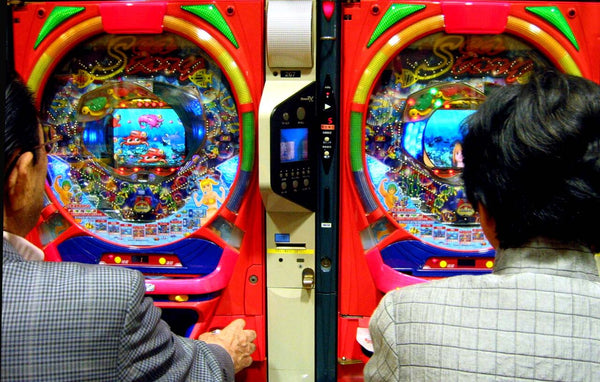
At its core, pachinko is a machine based game that blends pinball-style mechanics with modern electronic features. Players launch small metal balls into a vertical cabinet filled with pins, gates and moving elements. If the balls land in certain areas, the machine releases more balls, allowing the player to continue.
Sound a little like pinball, but with more (and smaller) balls? Well so far, it’s not all that different. And while pinball has a “high score” sense of accomplishment, pachinko balls are then used to keep playing or exchanged for prizes when the player is finished.
Pachinko has been part of Japanese leisure culture for decades and remains widely visible across Japan. You will find pachinko parlors in major cities and nightlife districts, but also near suburban train stations and local shopping streets… even in standalone buildings in small towns or near expressways.
A Brief History of Pachinko in Japan
Pachinko developed from early mechanical games into a widely popular form of entertainment in Japan. It became established as an adult pastime in the 1920s–1930s and spread rapidly across urban areas.
Many parlors closed during World War II (1939–1945), followed by a strong resurgence in the late 1940s, when pachinko emerged as a mainstream leisure activity. Over time, machines evolved from simple mechanical designs into the highly animated electronic cabinets seen today, particularly from the 1970s onward.
Modern machines, common from the 1990s to the present, often feature elaborate themes, licensed characters, and dramatic visual effects, reflecting advances in technology and shifts in popular culture.
Is Pachinko Gambling? Is Gambling Legal in Japan?

Photo by Issei Kato/Reuters
Yes, pachinko is a form of gambling, but it operates in a legal gray area in Japan.
Pachinko parlors are classified as “amusement businesses” rather than casinos. Pachinko remains legal because players do not exchange winnings directly for cash inside the parlor.
The caveat here is that, “outside” and “away from” the pachinko parlor, you can redeem a “marker” or “chip” (handed to you inside the pachinko parlor) for… cash.
Because of this structure, pachinko is often described as “quasi gambling” or gambling-adjacent. The pachinko experience clearly involves wagering elements, but it operates under a different framework than casinos in countries where cash-based gambling is openly regulated.
Gambling itself is highly regulated and mostly illegal in Japan. The exceptions are for “event” types of wagering, such as horse racing (aka “keiba” which is also a big thing in Japan). Casinos are generally not found in Japan.
But… then there’s pachinko.
Pachinko Basic Gameplay Rules

Photo by Issei Kato/Reuters
Pachinko gameplay is simple at a basic level. Players first exchange cash for metal balls, then sit at a machine.
By turning a handle, balls are launched into a vertical cabinet filled with pins and moving parts. Most balls fall quickly, but some land in winning areas that trigger animations and release more balls. Successful hits release additional balls and players can use these balls to keep playing or stop at any time.
When finished, balls are exchanged for prizes. More on that below.
How the Pachinko Prize Exchange System Works

Photo by Issei Kato/Reuters
Unlike casinos, players do not usually receive cash directly when they finish playing pachinko.
Instead, balls are exchanged for prizes according to the rules of the parlor. The exact process varies by location, but this prize based structure is a defining feature of pachinko and one reason it occupies a different category from direct cash gambling.
The prizes could be things like snacks, stationery… or “special prizes.” Pachinko players who prefer cash (which is, let’s say, almost everyone)? Well, it’s the “special prize” that’s the play here.
Whatever that special prize is (a piece of plastic, or a pen or something), effectively it’s a “marker” or an “IOU.” And while this is worth nothing “inside” the pachinko parlor, it’s going to be worth cash money if taken to the right place “outside” the pachinko gaming hall.
Where? Well, usually it’s a nondescript window around the corner or down the street. And that, friends, is the cashier. Yup, that seemingly worthless item handed to a player inside the pachinko parlor is suddenly worth cash at another, technically unrelated (but clearly “connected”) nearby location.
So… it’s gambling, right?
Let’s say for our purposes that it is. And thus, for visitors, the better approach is to treat pachinko like paid entertainment. Set a budget. Play for a short time. Exchange your accumulated ball bearings for a small prize if you wish. Then move on and enjoy the rest of Japan.
Pachinko vs Casinos: Key Differences Visitors Should Know
If you come from a country where casinos are common, pachinko may feel familiar for a moment, then immediately feel different.
Casinos revolve around table games, slot machines and direct cash in cash out systems. Pachinko revolves around individual machines, metal balls and prize exchanges.
The atmosphere is also different. Casinos often emphasize social energy and shared experiences at tables
Pachinko is largely solitary, more like video poker or slot machines at Vegas-style casinos. Players sit quietly at their machines, focused and self contained, even while surrounded by noise and flashing lights.
What Is a Pachinko Parlor Like Inside?

Photo by Issei Kato/Reuters
Pachinko parlors are intentionally intense spaces. The lighting is bright. The machines are visually busy. The sound is constant and loud.
For many first time visitors, the initial impression is sensory overload.
At the same time, the mood inside is usually calm. People are focused on their own machines. There is very little conversation. Movement is minimal aside from short breaks.
A few practical observations can help set expectations:
- The noise level can be extreme, especially in busy sections
- Air conditioning is often strong
- Rules and notices are clearly posted, sometimes in multiple languages
- Smoking policies vary by location, with some parlors using designated smoking areas or separated sections
If you are curious but unsure, it is perfectly acceptable to step inside briefly, look around, and then leave.
Pachinko parlors typically attract a demographic that skews highly towards men, though not exclusively. The venues are stereotypically smoke-filled, though some pachinko parlors are starting to go smoke-free. And it’s not uncommon to see pachinko players hanging around outside near the establishment, either out for a smoke, waiting to get in, or maybe next door for a bowl of ramen.
The ramen shops around pachinko parlors can be really good, by the way, and they’re often open late into the night.
What’s the Deal with Tokyo’s Kabukicho and Pachinko?
Kabukicho, located in Shinjuku, is one of Tokyo’s most well known nightlife districts.
It is also a place where many visitors first notice pachinko simply because the area is dense with entertainment signage and late night activity.
It is important to approach Kabukicho with clear eyes. We’re not saying “don’t go there.” But, if you decide to go, know before you go.
Japan is one of the safest countries in the world, but Kabukicho is widely considered one of its rougher neighborhoods. Conditions can change dramatically from one block to the next, especially after dark. Some streets feel perfectly fine and heavily trafficked. Others are best avoided, particularly late at night.
A major feature of Kabukicho is touts. These are people who approach passersby offering bars, clubs or entertainment. Visitors should be cautious. Following touts is one of the most common ways travelers end up in uncomfortable or expensive situations.
Kabukicho is not inherently dangerous, but it demands more situational awareness than most parts of Japan.
For families, Kabukicho is generally not an appropriate area to visit at night. The one common exception is the Toho Cinema building with the Godzilla head, which many people visit briefly for photos. Outside of that, it is best to avoid bringing children into the neighborhood.
Staying overnight in or near Kabukicho is also something many travelers regret. While hotels exist there, the area can be noisy, chaotic and unpredictable late into the night.
When it comes to pachinko specifically, Kabukicho is not an ideal place for a first experience. While pachinko parlors there are not inherently unsafe, they are surrounded by a broader nightlife environment that can complicate what should be a simple and optional cultural stop.
If you are curious about pachinko, you are generally better off visiting a parlor near a major station in a regular commercial area. These locations are more open, more straightforward and easier to leave without pressure or distraction.
How to Choose a Pachinko Parlor as a Tourist
If you decide to try pachinko, where you go matters more than many people realize.
For a low-stress experience, look for pachinko parlors near major train stations in business districts or residential areas. These tend to be brighter, more open and easier to navigate. Staff are often accustomed to casual players and short visits.
Avoid making your first visit to areas dominated by nightlife. In those environments, pachinko is just one piece of a much larger entertainment ecosystem, which can add unnecessary complexity.
A good rule of thumb is this: If the surrounding area feels comfortable during the daytime, it will likely feel comfortable at night as well. If the surrounding area already feels chaotic or aggressive, pachinko is probably not a good call here.
Pachinko Etiquette and Basic Rules for Visitors

Photo by Issei Kato/Reuters
Pachinko parlors are adult environments. If you decide to enter one, a few basic guidelines will help you feel more comfortable.
- Do not bring children: Minors are not permitted to enter pachinko parlors. Some venues also restrict high school students even if they are eighteen. Same goes for much of Kabukicho in general, and a few other neighborhoods in Tokyo and Osaka.
- Follow posted rules: Photography is often discouraged. Smoking rules vary. Look for signage and follow it.
- Respect personal space: Players focus on their machines: Avoid standing close behind someone or blocking aisles.
- Keep your visit simple: You do not need to stay long. A brief visit is completely acceptable.
What to Expect as a First-Time Pachinko Player
For most travelers, pachinko is optional. It is a cultural curiosity rather than a must-do experience.
If you do try it, go in with realistic expectations:
- It may feel confusing at first
- The environment may feel overwhelming
- It can be briefly fun as a novelty experience
- It can also be easy to spend more than planned if you are not careful
The most effective approach is also the least dramatic. Decide your limit before you enter. Stick to it. Leave when it stops being enjoyable.
Pachinko involves wagering. If gambling is a concern for you or someone you are traveling with, this is an easy experience to skip.
Japan offers no shortage of alternatives, from food culture and neighborhood exploration to museums, crafts, design and nature. Pachinko is only one small part of the broader cultural landscape.
If you are simply curious, keep it light. Treat it as an optional experience, stay aware of your spending, and remember that you are never obligated to play.
If you enjoy learning how everyday life works in Japan, Japanese Taste has got plenty of culture focused articles that explain customs, trends, and parts of daily life that visitors often notice but do not always understand.
Enjoy your travels in Japan!


0 comments