
Jump to:
What do Japanese people do for Valentine’s Day?
Well, in a word: Chocolate.
But it’s not exactly a “mutual” thing per se. Rather, the gifting of Valentine’s chocolate is wrapped in a cultural context, and deferred for one half of the arrangement.
If you spend February in Japan, you’ll notice women give giri choco to men on Valentine’s Day. Some also give honmei choco to… someone special. And those gifts are reciprocated in March, on a whole other occasion called White Day.
In this article we’re exploring the fascinating cultural traditions of Japanese chocolate gift-giving on (and after) Japan's Valentine’s Day. We’ll talk about when chocolate is given, why and to whom it’s gifted, and what you should know as either a visitor to Japan or an admirer of Japanese culture (and Japanese chocolate, of course!).
Why Chocolate Is the Main Gift on Valentine's Day in Japan

If you visit Japan in February, it can feel like the entire country has agreed to think about chocolates at the same time.
Department store floors turn into pop-up chocolate festivals, convenience stores stack special displays … heck, even places that normally sell office supplies or non-food-related items suddenly have gift chocolates at the register.
What surprises many visitors is not how much chocolate there is, but who is giving it to whom.
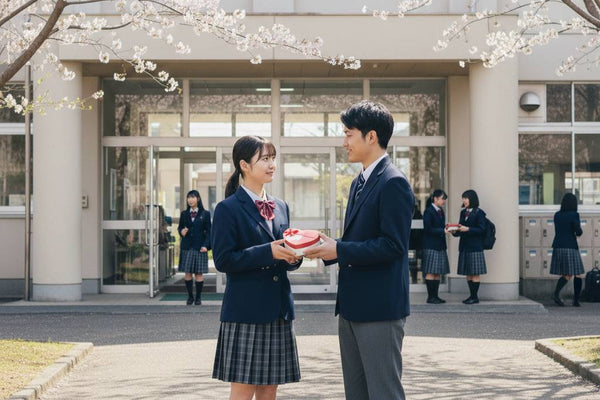
Japan's Valentine’s Day works differently from many Western countries. Traditionally, women give chocolate to men, then one month later, on White Day, men reciprocate the favor.
Within that system, there are two main types of Valentine’s chocolate, and they carry very different meanings: giri choco and honmei choco.
Ever wondered what these terms actually mean, how seriously people take them and whether visitors or expats are expected to join in? Keep reading to discover a clear and realistic explanation.
What Is Giri Choco? Obligation Chocolate in Japan Explained

Giri choco literally means obligation chocolate. The word giri refers to social duty. In practice, giri choco is chocolate given out of politeness, not romance. It is a way to say “thanks for working together” to coworkers, supervisors, clients, or classmates, with no emotional or romantic meaning attached.
Traditionally, giri choco was given on Valentine’s Day by women to male coworkers, supervisors and sometimes business partners. It was not limited to young people. Office workers of all ages participated.
Today, practices vary widely by workplace. Some companies discourage gift exchanges entirely to avoid social pressure. Others treat giri choco as a light seasonal gesture that people can join or skip without consequences.
In smaller teams, coworkers may agree together whether to exchange sweets. Among friends or classmates, giri choco may appear in group settings where everyone brings something simple to share.
The key point is that there is no single rule that applies everywhere anymore.
Giri choco is meant to be modest. The goal is inclusion rather than personal expression. That is why multi piece chocolate or individually wrapped snacks are so common, like KitKat chocolates or the popular Muji chocolate-covered chocolates.
Typical giri choco gifts include:
- Small chocolate assortments
- Individually wrapped biscuits or candy
- Simple boxed sweets meant for sharing
Prices are usually kept low, especially when buying for several people. Spending too much can actually create discomfort, since it may suggest stronger feelings than intended.
In giri situations, keeping things simple is often the most polite option.
If you wanna discover more options, read our guide on the best chocolate brands in Japan.
What Is Honmei Choco? Romantic Valentine’s Chocolate in Japan

Honmei choco is the opposite.
Honmei refers to true feelings. This is chocolate given to someone you genuinely care about, often a romantic partner or someone you hope to become closer to.
Honmei choco is usually more thoughtful. It might be higher-quality and beautifully packaged chocolate, like these matcha truffles or even handmade chocolate.
Some people plan it carefully, especially teenagers and young adults who treat Valentine’s Day as a big emotional moment.
Unlike giri choco, honmei choco is personal. It is not about social balance or workplace harmony. It is about affection and sometimes about taking a small emotional risk.
Because of that, people tend to be very clear about which category their chocolate falls into. Confusion in this area can get awkward fast.
Other Types of Valentine’s Chocolate in Japan (Tomo, Gyaku, Jibun)

Over time, more categories have appeared, partly as a way to make Valentine’s Day feel less rigid and more flexible.
- Tomo choco is friend chocolate, given between friends without romantic meaning
- Gyaku choco is reverse chocolate, where men give chocolate to women on Valentine’s Day rather than waiting for White Day
- Jibun choco is self chocolate, which people buy for themselves simply because they want good chocolate
Jibun choco has grown especially popular in recent years. Many people now treat Valentine’s season as the best time to buy premium chocolates, like Lindt, Royce, and MeltyKiss, which they would not normally justify for everyday snacking.
In other words, sometimes the most serious Valentine’s relationship is between a person and a really good box of chocolates.
What Is White Day in Japan? How Valentine’s Gifts Are Returned

White Day on March 14 is when men traditionally give gifts to the women who gave them chocolate on Valentine’s Day.
The “reciprocal” gift (not literally returning the same exact box of chocolates, mind you!) is often expected to be similar in value or slightly more generous.
White Day gifts are not limited to chocolate. Cookies, candy, small accessories and other sweets are common. In romantic situations, White Day may be used to confirm mutual feelings that were hinted at on Valentine’s Day.
In giri situations, White Day reciprocations are usually practical and simple, similar in scale to what was received.
Should Visitors or Expats Give Valentine’s Chocolate in Japan?
In my experience, no one expects it.
If you are visiting Japan, you are not expected to participate in local Valentine’s traditions. If you live in Japan and work in a Japanese office, expectations depend entirely on company culture.
If colleagues exchange small gifts and you want to join in, bringing simple chocolates to share can be a friendly gesture. If no one else is doing anything, you are under no obligation to start.
When in doubt, it’s probably better to match the tone of the people around you rather than trying to follow formal rules you read online.
How Valentine’s Day Traditions Are Changing in Modern Japan
Younger generations in Japan tend to see Valentine’s Day more as a chance to enjoy good chocolate than as a structured social ritual.
Jibun choco and tomo choco continue to grow in popularity, while giri choco is seeing a decline in many workplaces.
At the same time, the chocolate industry still leans into the tradition because it creates a strong seasonal moment for new products and limited editions.
So while the social rules are softer, the chocolate displays remain intense.
If this inspired you to create a more meaningful Valentine’s Day at home, check out our Valentine’s gifts for him and her, featuring thoughtful Japanese items made for sharing and everyday use.
Planning a cozy night in instead? Try our Valentine’s recipes, with easy Japanese-inspired dishes and desserts you can make together for a relaxed, romantic evening at home!


0 comments